
PowerCo Customer Churn Analysis
This project analyzed customer churn for PowerCo using client, contract, and pricing data. After EDA, feature engineering, and Random Forest modeling, the results showed that contract duration and energy consumption are the strongest churn drivers, while price sensitivity plays only a minor role. The model was not fully optimized, but it successfully answered the key business question, providing clarity on retention strategies and opening space for future model improvements.

Customer churn is costly for energy providers like PowerCo, and management wanted to know: “Is churn primarily driven by price sensitivity?”
The dataset included customer demographics, contract details, pricing history, and energy consumption. The challenge was to clean and engineer features, then apply machine learning to identify the true churn drivers and inform retention strategies.
Data Cleaning & Preparation
Imputed missing values (contract end dates, competition distance, pricing fields).
Converted dates to
datetime, fixed data types.Encoded categorical variables (e.g., sales channel, customer origin).
Feature Engineering
contract_duration→ time between activation and renewal.price_sensitivity→ gap between forecasted vs. actual costs.customer_loyalty→ tenure in years as a client.One-hot encoded categorical variables.
Scaled numeric features (energy consumption, prices).
Modeling
Split: 75% train / 25% test.
Trained a Random Forest Classifier to handle mixed features.
Used GridSearchCV for tuning
n_estimators,max_depth,min_samples_split.Evaluated on churn prediction accuracy and feature importance.
This section highlights some of the patterns uncovered during data exploration and feature analysis. These visuals illustrate the key drivers of churn at PowerCo, from sales channel performance to consumption behavior and feature importance rankings.
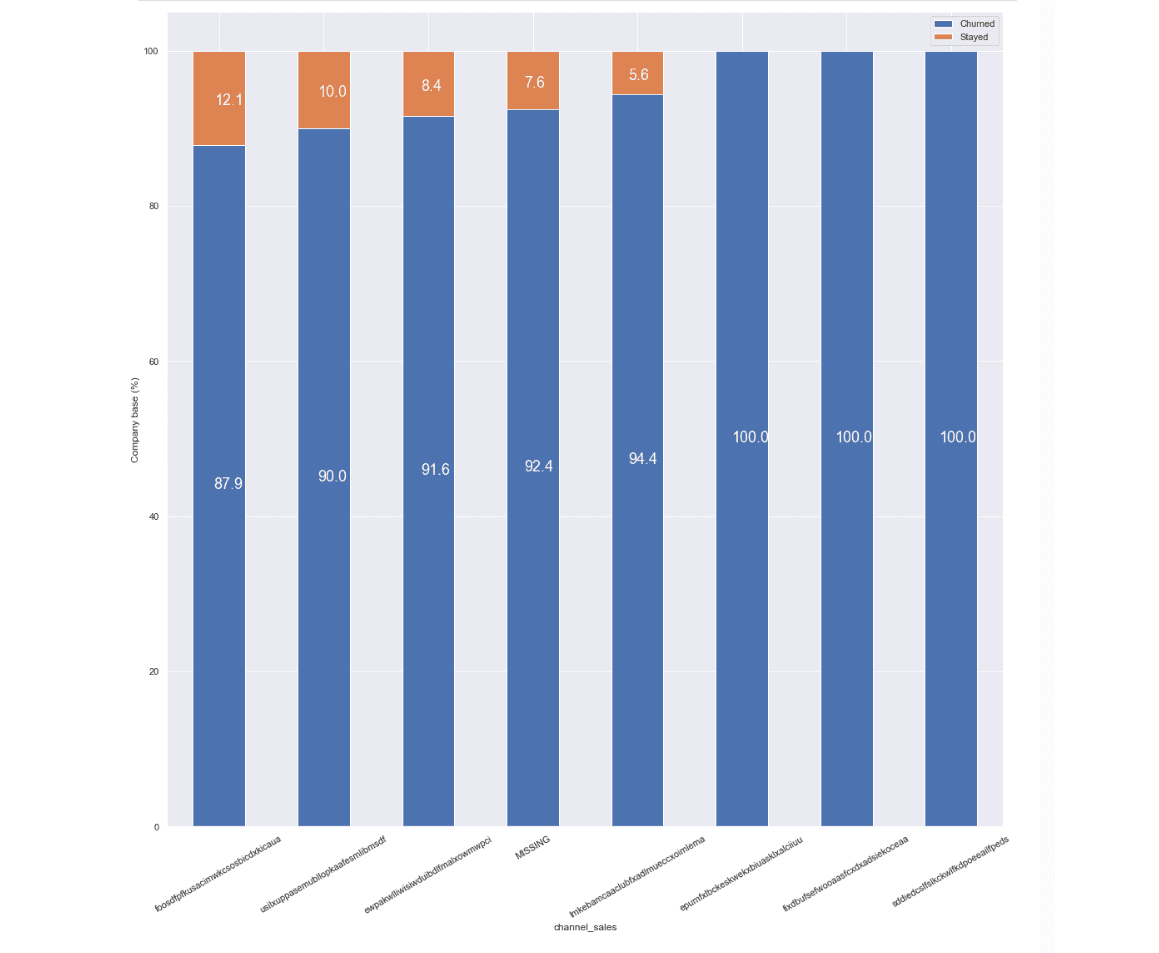
Churn by Sales Channel
Certain sales channels showed much higher churn rates than others (e.g., 10–12% vs near 0%). This suggests churn is not evenly distributed across acquisition paths, and PowerCo may need to re-evaluate sales practices or support in those channels.
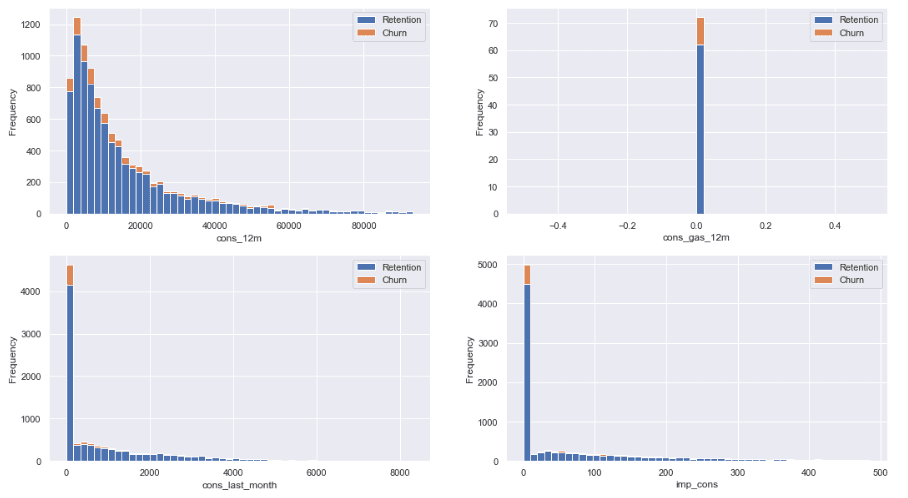
Churn by Consumption (after removing outliers)
Customers with lower electricity consumption were consistently more likely to churn compared to heavy users. This aligns with the insight that low-usage customers are less sticky and may be more price-sensitive or opportunistic.
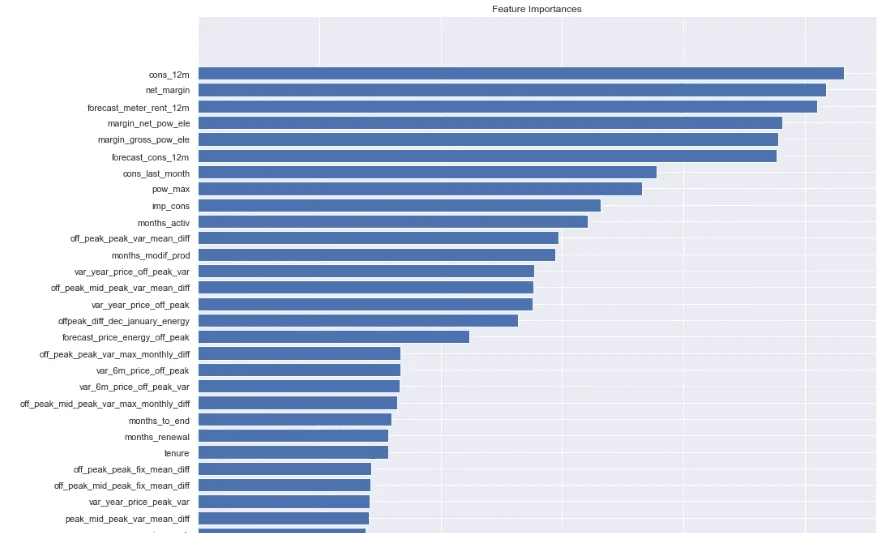
Feature Importance (Random Forest model)
The Random Forest model ranked contract duration, consumption (12m), and net margin among the top churn drivers. Interestingly, price sensitivity features ranked lower, confirming that contract and consumption patterns outweigh pricing in churn prediction.
Contract Length → shorter contracts strongly correlated with churn.
Energy Consumption → low-usage customers were more likely to leave.
Price Sensitivity → had an effect, but not dominant — disproved assumption that pricing was the main churn driver.
Business Implication → retention cannot rely solely on pricing; must include personalized contract strategies and loyalty programs.
Try Gradient Boosting (XGBoost, LightGBM) for stronger accuracy.
Explore time-series forecasting for contract renewal risk.
Add customer segmentation (e.g., cluster churn-prone groups).
Incorporate external competitive pricing data for more realistic price-sensitivity modeling.
+61 421 718 726
thanhthao.chu05@gmail.com